By: Lisa J. Manterfield My husband and I were at a major crossroads in our lives and in our relationship. Behind us were five years of trying to start
via Two’s a Family.
filling the silence in the motherhood discussion
By: Lisa J. Manterfield My husband and I were at a major crossroads in our lives and in our relationship. Behind us were five years of trying to start
via Two’s a Family.

I saw this Cathy cartoon in this morning’s LA Times and at first it made me laugh with the intended joke, as well as the gentle dig at support groups. But then I whipped out my childless glasses and took another look. As Cathy would say, “Ack!”
I’m looking at the expression on Cathy’s face and wondering what’s going on in her mind. If you follow Cathy at all, you’ll know that she too is childless, although it’s never really mentioned, and it’s not clear (at least to me) if this is a choice or a circumstance for her. Either way, she discovers that she has even less in common with her newfound friend, and that she’s more alone than she thought she was.
Yes, it’s a cartoon, yes, I know I’m reading far too much into it, but childlessness is a filter I bring along with me in life now and, whether I like it or not, it tints everything I see.
 Reader Sarah posted this excellent quote on her blog, Five Camels. This is one of those quotes that makes me want to get up and shout, “Amen!” And when applied to living a childless life, it just resonated with me.
Thanks Sarah.
It’s been a funny week this week and I’ve learned a lot about myself. The main thing I’ve learned is that I’m not yet completely comfortable with this whole childless thing. Oh yeah, I talk a good talk, but put me in a conversation where the subject comes up of my status with regards to children, and there I am squirming in my seat, averting my eyes, and deftly changing the subject.
This has happened twice to me this week, both times in the company of other women who are also childless. You’d think I’d be comfortable in that situation, and able to talk openly about my childless status and my story, you know, the one I’m so happy to put in writing for complete strangers? But I’m not. Not quite.
I’m still a little raw about the education I received this week and I still haven’t had time to think it over, to scratch away at my own veneer and try to figure out what’s going to underneath. Maybe I don’t want to risk getting one of those sympathetic looks, one of those, “Oh, you poor thing. I completely understand” looks. Maybe I don’t want to feel I have to explain my childlessness. Or maybe I don’t want my childlessness to define me and so I just don’t want to talk about it any more.
All I know is that if I’m going to tout myself as some kind of advocate for childlessness, I’ve got a lot of work to do on myself first.
 Every Sunday, The New York Times publishes essays in its Style section, under the heading Modern Love. They’re always worth a read. I recently stumbled across this gorgeous essay about infertility, Alone on a Path Shared By Many, by Allison Amend.
Here is a woman who dealt with the blow of infertility long before she was ready to have children, but she expresses the loss and grief beautifully, and her brother’s well-meaning comments need to be added to our list of the amazing things people say.
Kudos to Allison for her frankness.
 After posting yesterday’s article about surrogates in India, I came across this Op-Ed piece about a study that looked at the emotional impact on children conceived through sperm and egg donation. Here’s what the researchers found:
“a population that’s at once grateful to the fertility industry and uneasy about the way they were conceived, supportive of assisted fertility but haunted by the feeling of being a bought-and-paid-for child.
Americans conceived through sperm donation also are more likely to feel alienated from their immediate family than either biological or adopted children. They’re twice as likely as adoptees to report envying peers who knew their biological parents, twice as likely to worry that their parents “might have lied to me about important matters” and three times as likely to report feeling “confused about who is a member of my family and who is not.”
And the realities of commercialized reproduction — in which desirable donors can father dozens of children by different mothers, creating far-flung networks of half-siblings who will never know each other — weigh heavily on them. They are more likely than adoptees to say that “when I see someone who resembles me, I often wonder if we are related,” for instance, and much more likely to worry about accidentally falling into a romantic relationship with a relative.”
I found this fascinating and wonder how many parents consider this, and if it’s just one of those issues that will need to be dealt with if and when it arises. I know that when I was faced with the possibility of first sperm and later egg donation, these findings didn’t occur to me. Something didn’t feel right to me, but that’s all that I really knew.
I think that now I am probably looking for justification of my decision to not have a baby by any possible means, but if so, I’m having no trouble finding evidence to support my case.

This story makes my head spin. I need to pick a corner and say something about this, but there are so many corners to choose from, I’m going in circles.
On the one hand, I keep trying to convince myself that these women in India are happily carrying babies for wealthy Westerners because the $7,500 they’ll receive will give their own families a better life. The latter is true. It could take these women three years to earn $7,500 in a normal job. But “exploitation” is a word that won’t stay out of my mind. Would these women do this job if they weren’t desperate? There’s a whole list of exploitive ways for women to make money when they’re up against a wall. Is this job anything more than prostitution?
And of the people who use the service. Some claim they are ordinary people who couldn’t afford the $75,000 it would cost to use a U.S. surrogate; some are getting around their own country’s laws; others are just looking for a bargain. They’re all buying babies.
But I understand that maniac desire for a child; I can see how someone could see this as perfectly acceptable.
OK, I’m picking my corner now.
This is madness, utter insanity. This unbridled quest for motherhood is totally out of control. We live on an overpopulated planet; we have unwanted children all over the place, so why are we going to such extremes to create more? This has become absolute mania and at some point this bubble is going to pop. Just as the stock market had a meltdown and just as the real estate market blew itself up, I predict that somewhere down the line, the baby market is going to self-destruct. And it’s going to be a horrible unhappy mess when it does.
OK, I’m done. Going back to my room now.
 Reader Lynne posted a comment recently about responding, or rather being unable to adequately respond, to a colleague’s pregnancy announcement. Her story got me thinking that what we need is a Handbook that we can refer to in sticky situations, and let’s face it, there’s never a shortage of those.
The idea is that we can all chip in with our best responses to situations and questions we’ve all faced and I’ll compile the answers, maybe on a new Handbook page. This shouldn’t be taken too seriously, but you never know, your witty response to someone’s thoughtless question might just save someone else.
So, let’s kick off with Lynne’s conundrum:
A colleague announces that she’s pregnant with twins. How do you respond?
Answers below, please.
 In her wonderful blog The Road Less Traveled this week, Loribeth posted a great piece about former First Lady, Laura Bush and her new memoir, Spoken from the Heart. In the book, Mrs. Bush reveals her own battle with infertility as well as her mother’s pregnancy losses and how those affected the whole family. Loribeth included a very insightful excerpt from the book, which I now share here.
“The English language lacks the words ‘to mourn an absence.’ For the loss of a parent, grandparent, spouse, child or friend we have all manner of words and phrases, some helpful, some not. Still, we are conditioned to say something, even if it is only ‘I am sorry for your loss.’ But for an absence, for someone who was never there at all, we are wordless to capture that particular emptiness. For those who deeply want children and are denied them, those missing babies hover like silent, ephemeral shadows over their lives. Who can describe the feel of a tiny hand that is never held?”
It’s a beautiful quote and a sentiment I share.
I am always pleased when well-known figures step up and admit to infertility, just as I am equally infuriated when glowing celebs parade their miracle offspring and deny any dealings with the “sordid” world of fertility treatments. But, I wonder: when are we going to get a true champion? What will it take to make infertility a suitable subject for polite company, and who is going to use their fame and power to stand up for the childless and help lift that taboo? I guess, sisters, we’re just going to have to do it ourselves.
 At some point in our lives, given a certain set of circumstances, we have all decided not to have children. The question is: If you had your life over again and you had the opportunity to have children, would you?
Post your response and leave a comment too if you have something more to add.
[polldaddy poll=3266291]

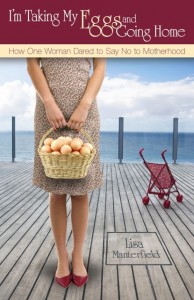
~ "a raw, transparent account of the gut-wrenching journey of infertility."
~ "a welcome sanity check for women left to wonder how society became so fixated on motherhood."