It’s Whiny Wednesday, your opportunity to rant on a theme.
This week’s topic is:
Caring for elders and wondering, “Who’s going to do this for me?”
Feel free to add your own whines, too.
filling the silence in the motherhood discussion
It’s Whiny Wednesday, your opportunity to rant on a theme.
This week’s topic is:
Caring for elders and wondering, “Who’s going to do this for me?”
Feel free to add your own whines, too.
As told to Kathleen Guthrie Woods
 After a first marriage to a man who was “never stable enough for us to have kids,” Kay* met her current husband when she was almost 42. They got busy trying to create their family, but three pregnancies were lost early, and adoption didn’t work (they weren’t against it, but the reasons it didn’t work were “complicated”). Now 52, Kay still struggles with being childfree by chance and circumstance. After reading her story below, I hope you’ll take a moment to offer her some encouragement in the Comments.
LWB: Please briefly describe your dream of motherhood.
Kay: Oh, the Waltons. I wanted a big family with lots of children, maybe with foster kids as well.
LWB: What’s the hardest part for you about not having children?
Kay: My parents didn’t have a clue how to show love and fought a lot, and we children felt truly unloved and unwanted. From a very young age, all I wanted in life was to be a mama. That I will never have that is crushing. We are not close to any of our nieces and nephews. We have tried, but we live too far away from them to be very involved.
LWB: What’s the best part about not having children?
Kay: I don’t have to discover that I am just like my parents in parenting, in spite of my best intentions.
LWB: How do you answer “Do you have kids?”
Kay: I really, really struggle with this because I so want/wanted to be a mama, and I want to relate to other people. Trying to explain, however, becomes complicated. I frequently get, “You could always just adopt,” which is a more complicated conversation. I’ve found it best to just answer, “No.”
LWB: What’s your Plan B?
Kay: I still very much want children in my life, and it doesn’t matter to me now that they won’t be my own. We unofficially mentored a family for a while. We called them our “Rent-a-Kids” and they liked that. But they moved away, so now I’m looking for something similar. I would like to find a way to connect “aged out” foster kids with people who would be family for them, to give them someone to care about them and a place to go for holidays and other momentous occasions. I don’t quite know how to get this started, but I’ve recently come across a couple of possibilities.
LWB: Where are you on your journey now?
Kay: I still struggle with hearing pregnancy announcements, and frequently give a big sigh when I read stuff on Facebook about friends’ kids/grandkids or their parenting stuff. Early on I told myself, “This is not how your life will turn out. You will not have this.” It was an attempt to work for acceptance, but I eventually gave it up as it was turning into a self-pitying whine instead of acceptance. Sometimes I’m angry, more often I’m wistful. I frequently quote Agatha Christie: “Life is badly arranged.”
*To protect respondents’ privacy, we allow each to choose a name for her profile. It may or may not be fictitious.
Won’t you share your story with us? Go to the Our Stories page to get more information and the questionnaire.
Kathleen Guthrie Woods is a Northern California–based freelance writer. She is mostly at peace with her childfree status.
By Paulina Grace Hay
 One thing I’ve felt and heard many times is about being locked out of the “Mommy Club”—a club we felt we had a natural right to join, no special requirements necessary. Then infertility, illness, age, or time black-balled us. We stand wistfully outside trying to get a peek of the mothers inside living their ideal lives. We imagine all the judgment about our “child-free” lives will be washed away once we walk through those golden Mommy gates.
I live in an odd situation where my life straddles having no kids and having one kid. I have a teenage stepson. He was a toddler when I started dating his father. I am not a full-time stepmother and my son’s mother is very active in his life. Due to this unexpected loophole, I have been granted a “special guest pass” into the Mommy Club. But with restricted privileges. I’ve been outright ignored, given the once over, and warmly greeted. Sometimes by the same person.
I found my place at the club in the fly-on-the-wall seat. I’ve done my share of listening and observing over the years from this post. From the moment a woman is pregnant, people have lots of opinions to share in front of her face and behind her back. I’ve watched the awkward “Congratulations” and subsequently more awkward baby shower for the 19-year-old who got admitted too soon. I’ve watched one mother look down her nose at another for paying for lunch milk rather than packing it. I’ve heard one mother refer to another’s young child as “homely”. In return came an insult about their son’s need for a haircut. I’ve watched smiling faces drop like lead balloons after having an unexpected insult directed their way. I’ve heard the voices lower and eyes begin shifting as a group insult gains momentum.
If anything, admittance into the Mommy Club only ramps up your potential areas of judgment. Some are the old stand-bys. Your age. Your weight. Your hair. Your outfit. Your car. Your house. Your husband. Your ex-husband. Your job. Your decision to stay home. Then multiply all of those things by your child and husband. Possibly your parents and your dog, too. How you raise your kids has the highest potential for conflict of all.
The Mommy Club is not for the faint of heart. Often I saw these women enter with full armor on, even if it looked like yoga clothes, in the chance a battle may begin at any time. Very different to the rose-colored version I imagined, where a new mother would be greeted with open arms and loving support once inside the club walls.
My biggest lesson from access into the Mommy Club is this: Being a mother does not make you automatically connect with another person. I’ve found the same holds true for infertility. It just might give you something to talk about for a few minutes or a few get-togethers. We are more complex and interesting than our children. Or lack of them. I choose to instead consider that we are all part of the Human Club. And for that, there is no special admittance required.
Paulina Grace walked away from the infertility roller coaster six years ago. She hopes to help other women let themselves grieve and then let themselves live. Outside of running her own business, Paulina fulfills her need to nurture by being an involved aunt and caring for her aging parents.
As told to Kathleen Guthrie Woods
Gwen*, now 44, has endured a rough journey of loss and infertility treatments, but she still hopes for a miracle. Like many of us, she dances around the pros and cons of being childfree as she considers what her Plan B might look like. Do you see yourself in her story? If so, take a moment to reach out to her in the Comments.
LWB: Please briefly describe your dream of motherhood.
Gwen: I told myself that if it didn’t happen by 36 I would not pursue it. It wasn’t until I was 39 and reconnected with an old flame—who I eventually married—that I wanted to try for a family. My husband had been a victim of parental alienation for over a decade, has had no connection with his own children for over eight years, and it was very important for me to be able give him a child we could raise together in a very loving family.
LWB: Are you childfree by choice, chance, or circumstance?
Gwen: It was by choice until the age of 39. Then, after three years of trying and having over a dozen conceptions/zero pregnancies/one early miscarriage, I sought infertility treatment. Two failed IVF (in vitro fertilization) cycles into two failed IUI (intrauterine insemination) converts; the doctors could do nothing for me. We can’t afford and are not morally on board with egg donorship. We are too old to adopt a young child, and I do not to want to put myself or my husband through the grueling process of rejection through adoption.
LWB: Where are you on your journey now? (For example: still in denial, angry, hoping for a miracle, depressed, crawling toward acceptance, embracing Plan B, all of the above.)
Gwen: All of the above. I still hope every month, still time intercourse for a possible miracle while fully knowing the eggs are bad and the outcome will most likely never change. Just this month we had a conception that failed. I now joke that my uterus is made of Teflon.
LWB: What’s the hardest part for you about not having children?
Gwen: Feeling like a social outcast. I just cannot get past that one. I’ve never followed the status quo my entire life, was a “late bloomer” with all things social growing up, and became a statistic as a child of divorce and divorced twice over myself. So giving up the battle and becoming yet another statistic is the hardest part for me. “Everyone else can have a child, why not me?” is what goes through my head every day.
LWB: What’s the best part about not having children?
Gwen: Not having to dedicate the next 18 years to being responsible for another human being. I can continue to “do my thing”, come and go as I please, work on my crafts whenever I want, enjoy life on my terms, and not lie in wait for what my offspring needs right now. Oh, and being able to get a full night’s sleep every night. That’s a biggie.
LWB: What’s your Plan B?
Gwen: As I am just coming to terms with being childfree forever, I guess it is wait and see. After three years of marriage we could apply to be a licensed foster home and hope to find an older child who will fit into our life. But that is another year waiting, and my thoughts on adoption might change by then. I’ll leave that in God’s hands.
*To protect respondents’ privacy, we allow each to choose a name for her profile. It may or may not be fictitious.
Won’t you share your story with us? Go to the Our Stories page to get more information and the questionnaire.
Kathleen Guthrie Woods is a Northern California–based freelance writer. She is mostly at peace with her childfree status.
By Lisa Manterfield
 Have you ever been around people who behave as if you can’t possibly know anything about life because you don’t have children?
I’m sure that all of us have heard the old chestnuts, “You wouldn’t understand; you don’t have kids” or “I didn’t understand until I became a mother” (which implies the same thing) or even “Only a parent could know how this feels,” as if being childless strips away all capability of empathy.
And then there are those situations where you just feel invisible, when the conversation about children and parenting is swirling around you and no one even bothers to make eye contact with you because what could you possibly contribute?
These instances make me think of the wonderful “Mr. Cellophane” number from the musical “Chicago.”
And even without clucking like a hen,
Everyone gets noticed now and then,
Unless, of course, that person it should be,
Invisible, inconsequential me.
Personally, I’m done with feeling insignificant because I don’t have kids. It took me a long time to get to this point, but now I hold my ground in conversation. I contribute when I can and simply listen and nod when I can’t, just as I would if I found myself in a conversation on any other topic on which I’m not an expert.
I also keep a list of amazing childless women in case I ever need to remind myself that we don’t need to be parents to make a difference. On my personal list is Amelia Earhart, Dian Fossey, Julia Child, and Juliet Gordon Low, who started the Girl Scout movement. If you need your own role models, Jody Day has put together an outstanding collection on Pinterest.
You’d be hard-pressed to call any of these women insignificant. I remind myself of this when I find myself allowing others to make me feel like less than who I am.
So what do you do when you start to feel like a Ms. Cellophane? Do you feign boredom, try to hop in with an intelligent anecdote, change the subject, or do you slip away and hope no one notices you’ve left?
By Kathleen Guthrie Woods
 I am a huge fan of watching kids of all ages participate in just about any kind of sporting or performing event. I don’t care if a player is running toward the wrong goal or if the opposing team scores the most points or if the knight in tin-foil armor has to have his lines whispered to him from the teacher behind the curtain. I applaud and enjoy it all.
Watching my own kids was one of the activities I most looked forward to participating in as a proud parent. Alas…no kids for me. And since it would be weird if I showed up to watch a random game at the park, I put the word out to siblings and friends to let me know when I could come watch their kids.
“Send me the game schedule,” I said to a friend after she complained to me about how much time she spends chauffeuring her boys to practices. “When’s the next match?” I texted to another friend after getting a video clip of her daughter scoring a game-winning point. Despite multiple requests, I rarely got a response. Finally I pinned one friend down. “I’m serious!” I said. “I really really want to go watch your daughter play.” “Really?” she said. “We didn’t send you the schedule because we didn’t want you to feel obligated, we didn’t want to burden you.”
What followed was an open chat about how much I loved watching kids play, how much I missed being able to watch my own kids play, and how I hoped I could ease my feelings of loss by watching her kids at play. She got it. She finally heard me, and a couple of weeks later I had a seat in the bleachers.
It’s not easy or fun putting ourselves out there like this, but if you’ve been sitting on the sidelines too long, I encourage you to persist. There’s nothing wrong with wanting to be part of the fun.
Kathleen Guthrie Woods is a Northern California–based freelance writer. She is mostly at peace with her childfree status.
 I know this is a tough weekend for many of you, as the Mother’s Day hoopla comes to head and you wrestle with taking care of yourself, fulfilling family obligations, and dodging the flippant “Happy Mother’s Day” greetings.
I thought we could use and emergency Whiny Weekend/Support/Retreat, so I’m posting this here and have also created a topic on the Community Forum, in case you need to just get away. I chose the image for this post so you can imagine yourself there if things get too wild.
So, hope you’re all doing okay. See you back here on Monday, when it will all be over.

Image courtesy TSNY/Bob Holzman
Unless you’ve been living under a rock for the past month and haven’t turned on the TV, logged onto Facebook, been to a grocery, drug, or card store, or checked your mail or your email box, you’re probably already aware that Mother’s Day is upon us. In my book this day easily trumps Halloween, Christmas, and Valentine’s Day combined for the worst day of the year to not have children.
I’ve written about Mother’s Day woes in the past (see below for some reruns), but this year I’m taking back the day.
Two years ago my friend and I bought Groupons for trapeze lessons. We somehow never managed to organize a date to go and last month we realized our passes would expire on May 14. We quickly scrambled our calendars and found a day we were both free. Sunday May 11 was the only option. I mean, what else would two childless women with British mothers have to do that day?
So, that’s it. We’re going. And honestly, I can’t think of a more fitting way to take back what was once the saddest day of my year than by flying through the air with the greatest of ease, as a magnificent non-mom on my flying trapeze!
***
If you’re struggling with Mother’s Day, here are a few past posts and encouraging comments that I hope will help.
My Bah Humbug to Mother’s Day, But Not to Mother (May, 2010)
Breaking Up with Mother’s Day (May 2011)
It Got Me Thinking…About Nurturers (May 2012)
Preparedness (May 2012)
Duck, Weave, or Cover? (May 2012)
Mother’s Day (May 2013)
By Paula Coston
 In Jewish culture, it’s an ancient tradition to plant a tree on the birth of a child: a cedar for a boy, a cypress for a girl. The child would then care for the tree; when she or he married, they would stand under a canopy made of its branches. There’s a Jewish text: ‘A person’s life is sustained by trees. Just as others planted for you, plant for the sake of your children.’ (Midrash Tanchuma Kedoshim 8)
I live in the UK, and in our country of Wales, over the last two years, hundreds of thousands of trees have been planted as part of a project to grow a sapling for every new baby born or adopted in the region.
But childless women like us have no upcoming generations. So my thoughts have returned recently to an inspirational woman in her late eighties. I already shared in a personal post here the wonderful gesture made by Salumarada Thimmakka, who lives in rural India. Teased and despised in her village community as a young wife without children, despite her gruelling job in a quarry she began to plant saplings, treating them lovingly every day as her own ‘offspring’. Gradually they grew into a stately, shady avenue of 284 banyan trees, now worth millions of dollars.Meanwhile, the U.S. has a time-honoured tradition of mass tree planting, with a dedicated day, Arbor Day, for which the commonest date amongst the various states is the last Friday in April. People, young and old, take part. The day’s founder, J. Sterling Morton, declared 140 years ago, “Each generation takes the earth as trustees”, again linking this activity to the upcoming generations.
Why not, like her, plant trees for the children we never had?
A few weeks ago, I discovered that the council in my pretty little Cotswold town in England was funding a new tree planting scheme along the banks of our renovated canal and fringing the ridges of my local park, overlooking a lake and weir: silver birches, rowans, oaks, maples. I saw a chance, and invited a childless friend and neighbour along.
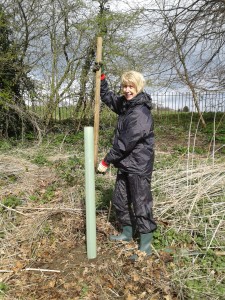
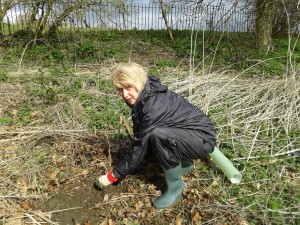
On Saturday March 22, we found ourselves under a spring sun flitting behind black clouds and threatening rainbows over the hills and valleys while we helped to dig holes, scoop moist earth round young roots, funnel weather guards over the saplings’ baby heads and drive in stakes to support them. I found myself asking the name of each plant, in some weird sense bonding with it, and even – unashamedly – talking to it as if it was a child. Kneeling beside the bed of each root ball, teasing out those little water-seeking veins, taking a moment to think about what I’d lost but what I was now giving to something living, was surprisingly moving and reviving.

My neighbour finds it hard to talk about her loss of children, but somehow, too busy digging to feel self-conscious, backs turned on each other, we began telling our personal stories of childlessness to each other.
On an impulse, I took out some postcards I was carrying in my backpack. For each young, vital thing I planted, I wrote a message to a child I never had and posted it into the tree’s new resting place among the soil. It didn’t cure my pain, but it felt like part of an answer.
I discovered something simple: that gardening, nurturing something other than a child, is great therapy for childlessness.
Paula Coston writes on childlessness, the older woman and singledom at her blog, http://boywoman.wordpress.com. Her novel, On the Far Side, There’s a Boy, comes out in June. It’s about an Englishwoman from the 1980s to now and her gradual discovery, through a link with a little boy in Sri Lanka, that she will never have a partner or children.
By Paulina Grace Hay
 8 years ago, a few weeks before my 30th birthday, I had my second miscarriage and a D&C. Physically, I recovered very quickly. Emotionally, I was in a tailspin that left me and my marriage in a pile of rubble. It looked like there would be no survivors. I wasn’t sure I wanted to survive.
There’s no handbook for moments like this and no one size fits all plan. It reminds me of the magic trick where they pull the tablecloth out from all the place settings. Everything rattles for a moment but quickly settles and looks untouched. To everyone else, it looks the same. To you, the foundation is gone in the blink of an eye. You can barely process what has happened to you, let alone explain what’s happened to your spouse or partner, your best friend and loved ones.
I read books like Welcome to Your Crisis. I went to therapy once and thought that was all I needed. I shut a lot of people out. That move cost me my best friend and almost my husband. I was back at therapy months later even though I thought I should be stronger than to need help. (I still struggle with that one.) I attended a Resolve group to meet other women like me. I tried a few infertility treatments and came to the gut wrenching but weight lifting decision to stop trying to have a child and re-embrace my life. I was 32.
In a couple of weeks, it will be my 38th birthday. I’m not one to dwell on numbers and usually being the youngest by far, I welcome a chance to be considered one of the “big kids”. Yet I’d been in a deep funk recently. I couldn’t shake it, I felt my anxiety escalating beyond my control. I decided to make an appointment with my therapist. I almost cancelled it.
He’s the one that said things to me like, “You have a birthday coming up.” and
“I feel like you’re not letting yourself feel some pain.” I was practically rolling my eyes and thinking, “Are you kidding me? Am I still here after all this time?” However, I trust this man so we went on. (The other interesting note is this is not the therapist who helped me through my infertility crisis. I’ve learned therapists help me with perspective and can give me emotional strength when I don’t have it. Bless the good therapists of this world.) We’ve never discussed my miscarriage or my marriage, as those aren’t the areas I felt I needed help with right now. I felt better when I left. I proceeded to start a fight with my husband when I got home.
The next day I was working from home alone and my husband was out of the home office for the day. I was doing the everyday task of cleaning the kitchen. My mind was wandering. I remembered my nephew’s birthday was coming up and I’d had the date wrong in my mind. It was later in the month than I realized. Then the trigger came like a bolt of emotional lightning. I’d had my D&C the day before his 2nd birthday and we drove to their house the next morning. I didn’t mention it to my family. A few weeks later everyone came to my house for my 30th birthday. We took a full family portrait. My one sister-in-law was already pregnant. My other sister-in-law was newly pregnant. I was in denial.
I started to cry. I hate to cry. I started to fight the tears. Without realizing it, I started to engage my Emotional Emergency Plan.
Let Yourself Feel The Pain
I remembered listening to Dr. Brene Brown talk about how she processes shame. One of the things she has to do is cry, even though she hates it, too. I let myself sink in the corner of the kitchen and sob. I wailed at my own pain.
Shame Can’t Survive Being Spoken
My first inclination was to process all of this alone, as I’d done many times before hiding in a closet or a bathroom. It would be perfect, no one had to know. I remembered Brene saying that shame can’t survive being spoken. I scrolled my emotional Rolodex. It’s uncanny how often you pick the worst person ever for support and end up feeling worse. For me, that would be my mom. I almost called her and thought better. (Thank you Martha Beck for that insight. )
Know What You Need and Ask For It, Even If You Don’t Get It
I wanted a friend. Not any friend. An old friend, someone who is like a sister. One who knew me before miscarriages and failures. One who told me when she couldn’t take it anymore hearing awful infertility stories because it made her feel guilty. One who had her own issues, even if she had 2 beautiful children of her own. I sent her a detailed text (thank you again Brene for reminding me to be clear on what’s going on so they understand I need their full attention) and finished it with, “I’m having a really hard time. Can you please call me?” I let her hear me cry and sob. I know it broke her heart. She wanted to fix it. It kind of irritated me but I know she just felt helpless. Then the best part of an old friend kicked in. We got through it and talked about a hundred other things. She can follow me from deep to frivolity without missing a beat.
Know What You Need and Ask For It, Part 2
I also wanted a friend who wouldn’t feel sorry for me, fix me or try to convince me that maybe I do want to have a baby. I texted an online friend who has also made the choice not to have children. Again, I told her exactly what was going on. She cleared some time for me and said, “It sounds perfectly normal to me.” A weight lifted. This is normal. It will pass. We talked about the grief of passing the fertile years of your life. She shared insights about leaving a sliver of hope in your heart. Yes, so true. We talked about other layers of life from aging parents, being entrepreneurs, friendships and life journeys. We’re so much more than our infertility. I told her of the good things in my life and she reminded me to keep following that trail.
Share With Your Partner
When my husband got home, I told him what happened. I didn’t text him. I told him face to face. I let him hug me when again, I’d prefer to hide and be alone. He has learned to just be with me and not try to fix it.
I still have more to share with him. It might just come through letting him read this post.
That night I had dinner plans with my husband’s family and then to see a niece’s play. She was one of many pregnancies that surprised and haunted me during that time. At dinner someone announced a pregnancy. On any other day, it wouldn’t have bothered me. However, without my preparedness plan engaged, I might have completely lost it at the table. I might have left that play heartbroken. But I was happy and so proud of my niece. I remembered how much I love my life. The storm had passed.
Is that the end of the story? No, but in an emergency you do what you can to get the wounds under control and then get more help. In an emotional emergency, calling in reinforcements is so key. Don’t go it alone and find a way to let it out, even if it’s on a piece of paper. Or a blog post. I’d love to hear how you handle an emotional emergency, too.
Paulina Grace walked away from the infertility roller coaster 6 years ago. She hopes to help other women let themselves grieve and then let themselves live. Outside of running her own business, Paulina fulfills her need to nurture by being an involved aunt and caring for her aging parents.

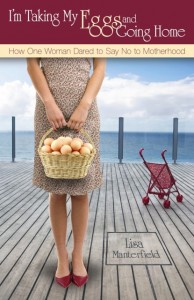
~ "a raw, transparent account of the gut-wrenching journey of infertility."
~ "a welcome sanity check for women left to wonder how society became so fixated on motherhood."