It’s Whiny Wednesday and this is one that always makes me scratch my head:
“Kids made me grow up.”
So, does this mean I’m not a grown-up? Because if so, I’d like to relinquish all these grown-up responsibilities I seem to have. How about you?
filling the silence in the motherhood discussion
It’s Whiny Wednesday and this is one that always makes me scratch my head:
“Kids made me grow up.”
So, does this mean I’m not a grown-up? Because if so, I’d like to relinquish all these grown-up responsibilities I seem to have. How about you?

By Lisa Manterfield
This year has been another busy year for travel. Between work-related trips and visits to family and friends, I’m feeling as if I’ve spent more time away from home than at home.
I’m not complaining. I enjoy travel and I’m also aware, if I had children, I couldn’t be doing this. If I had school schedules and missed classes to deal with, or frankly even if I had to find the money for three round-trip tickets instead of just one, it wouldn’t be feasible. Being childless not only allows me the do the fun things without worry, it leaves me free to take care of the other things that are important to me, namely my family—in particular my mother and husband.
There’s a downside to this freedom and independence, too. People often have expectations that a person without children is a person with nothing important to do, which equals the first person to be called when a favor is needed. Do you know what I mean?
Although my geographically undesirable location means I’m usually the last person to be called in for family help, some of my friends are given more than their share of the responsibility because of their childlessness. Quite often they’re called upon to organize family gatherings, take care of sick relatives, or just run errands because the family members with children don’t have the time.
I know that my childlessness affords me more freedom than many of peers who are mothers, but that doesn’t mean I’m sitting around idly looking for something to do. If I had children, my life would be full. But guess what? Because I don’t have children, I’ve made certain my life is still full, whether others believe it is or not.
What do you think? Do family members assume because you don’t have kids you have nothing but time on your hands? Do you feel the lion’s share of family duties falls to you? And what are the advantages of freedom and independence you do get to enjoy?
Facebook has been the topic of many Whiny Wednesday rants, and rightly so. Social media in general has perpetuated a myth of happiness that can make any kind of pain feel worse. So this week, our topic is this:
“Other People’s Perfect Lives”
Let us know how you feel.

One of my greatest pleasures in running this site has been to watch the slow emergence of infertility and childlessness from the shadows. What was once a taboo topic and something most of us would never dream about discussing publicly is gradually making its way into broader channels. The private blogs written under pen names have become public and been picked up by outlets such as Huffington Post and New York Times. Celebrity infertiles have spoken up about their experiences, and the idea that not all infertility stories end with a child is slowly creeping its way into the public consciousness.
Although we still have a long way to go, we took a giant step forward recently when Gateway Women’s Jody Day took her story—and ours— to that very public stage, the TED Talk.
With her usual frankness and wit, Jody debunked many of the myths surrounding childless women, and made a crucial point for our tribe: We just want to be acknowledged and understood.
Here’s Jody’s talk. Enjoy.
By Kathleen Guthrie Woods
At a dinner not long ago, I shared some of the challenges we’ve faced with the raccoons that moved into our dining room wall. Yes, inside the wall. Damages to the vents, the doors, the walls. The fleas that have infested our laundry room and left me with itchy red bites all over my legs. Loud noises keeping us up all night. The costs of catching these critters and relocating them to wooded areas nearby. (We live in a big city, for Pete’s sake!)
I fielded questions about how they got in, how their nocturnal activities are making our dog go crazy, and what sounds they make (kind of a mewing by the babies, and a hissing-screech by the adults). But the question that stopped me in my tracks came from a nine-year-old:
“Wait…what’s a flea?”
He’d never seen one, never been bitten, never almost lost mind trying to end the onslaught by employing collars, sprays, high-pitched noise-emitting machines (those were the worst—and useless), dips, and bombs. And I hope he never does.
It’s unrealistic for me to expect that his life will be pain-free, but as I thought about how blissfully unaware of fleas he is right now, I allowed myself to think of other things I’d like my young friend to be free of:
Loneliness
Infertility
Ostracism
Bigotry
Bullying
Prejudice
Poverty – of pocket and spirit
We LWBers endure a lot of grief about being childless or childfree. Today, I wish you a different kind of –less and –free. I wish you a day of peace, of belonging, and of joy.
Kathleen Guthrie Woods is telling the story about her journey in The Mother of All Dilemmas. As she shares her quest to become a single mother (and ultimately embraces a life without children), she explores why society still appears to base a woman’s worth on how many children she has. Watch for updates on the book’s release here at LifeWithoutBaby.com.
We could easily compile an entire encyclopedia of unhelpful, and even hurtful, things people have said to us. I think this one stings as much as any:
“Everything Happens for a Reason”
Do you agree? Or do you have your own favorite “helpful” slight?
By Lisa Manterfield
I heard this beautiful interview with poet Edward Hirsch on the topic of grief, and I wanted to share it with you here.
You may be wondering why an interview with a poet about the death of his son has a place here, but listen carefully to what he says about loss, mourning, and the process of healing. So much of what he has to say is what I’ve also learned about healing from loss.
“There is no right way to grieve, and you have to let people grieve in the way that they can. One of the things that happens to everyone who is grief-stricken, who has lost someone, is there comes a time when everyone else just wants you to get over it, but of course you don’t get over it. You get stronger; you try and live on; you endure; you change; but you don’t get over it. You carry it with you.”
In his 78-page elegy to his son, he writes that mourning is like carrying a bag of cement up a mountain at night. There is no clear path to follow, but when you look around you, you see everyone carrying their own bags of cement.
As a poet, Hirsch used his writing, not as a way to escape grief, but as a way to express what he couldn’t otherwise say. One of the most striking points he makes is on the topic of healing and how our society talks about the need to heal. But, he says, in order to heal, you have to be able to grieve first.
Most of us have faced a lack of understanding about the loss we’ve experienced because we didn’t get to be mothers. We have no place to express that loss, and without facing it and acknowledging it, we don’t get to grieve and we don’t get to heal.
If you’re struggling with loss, have you found a way to express your grief? Even if you’re not a writer, could putting your feelings down in words help you move through your grief? I know it has helped me through mine.

As told to Kathleen Guthrie Woods
“I am on the swim up, but I haven’t broken the surface yet,” Lynn* says, in answer to where she is on her journey. “At the same time, I feel scared to break free of it, to let it go. I feel stuck; I’m scared to turn the corner.”
Now 41, she’s been on the infertility/ran out of time rollercoaster for several years. Although she’s starting to make peace with her path, she continues to wrestle with the heartbreaking losses of the dream of holding her newborn and looking into familiar eyes in a new face, the memories that will never be made, and “all of the love that I have to give to that child that will never be given.”
Yet she continues to look for hope. “Some people come out the other end of this situation and say that they now know how strong they are, and that they can get through anything,” she says. “What I am learning is that I can survive, and that it’s okay to feel all of it. It’s even okay to be weak sometimes.”
After reading her story, I hope you’ll reach out to her in the comments. Perhaps you can share with her your own answer to the last question.
LWB: Describe your dream of motherhood.
Lynn: I can’t honestly say that I spent my younger years yearning to be a mom like so many women do. I did want children, but it always seemed like a goal for the next phase of my life: when I was a little older, when I had a better job, when I had a husband, etc. I had a long-term boyfriend in my early 20s, and I wanted to get married and start a family, but he was not interested. I did finally leave him and spent the next 10 years being very single. By the time I was in my mid-30s, I was overwhelmed by the desire to be a mom. I had spent so many years concentrating on my job and dating, but I felt no purpose in my life. Most of the men I dated were a mess, and I started to doubt that I would ever find something real. I met my husband when I was 38, and he was definitely worth the wait. We started trying to get pregnant even before we got married, then quickly learned it was not going to be an easy road for us. We did all of the drugs, intrauterine insemination (IUI), and then in vitro fertilization (IVF).
LWB: Where are you on your journey now? (for example: still in denial, angry, hoping for a miracle, depressed, crawling toward acceptance, embracing Plan B)
Lynn: Can I be all of these things at once? (LOL) I guess I am crawling toward acceptance, but still struggling with a little bit of depression. And I would be lying if I said that I didn’t harbor a secret hope for a miracle way down deep inside of me.
LWB: What was the turning point for you?
Lynn: Not sure I have totally hit that yet, but we did a round of IVF a little over a year ago. They were only able to harvest one egg, and although it looked good at first, it didn’t end up taking. We have thought about using an egg donor, but my husband is not willing to put us in $25,000 worth of debt to do it. At our age, we wouldn’t have that paid off until retirement (if we were lucky enough to pay it off at all).
I had an early miscarriage a few months ago. It was the first time in my entire life I had ever been pregnant. It came and went quickly, and it has been awful. I had just started down the road to acceptance, and then it happened. After fighting the anger, depression, and heartache of not being able to have a child, there is a part of me that wants to come up out of the depths of all of this and see what the next part of my life is going to look like.
LWB: What’s the best advice you’ve received?
Lynn: My husband and I are seeing a counselor, and she told me that I am grieving and that it’s so important to try to channel the emotions I have into something healthy and constructive. I have been journaling a lot, and it seems to be helping.
LWB: What advice would you like to give to your younger self?
Lynn: Be aware of your fertility and be proactive about it at an earlier age. Don’t just assume that you have forever to make it happen or that because celebrities have children in their 50s or your aunt’s cousin’s mother got pregnant when she was 47 that you can too. It’s harder than you think, and much harder than we are led to believe by our culture and media.
LWB: How has LWB helped you on your journey?
Lynn: The honesty and empathy shown here is everything. When I read women’s stories and read your posts, I don’t feel alone. Thank you for that.
LWB: What is your hope for yourself this coming year?
Lynn: That I could reach past the survival phase and reach a place where I can thrive. I want to find myself again. I feel like my personality, my “mojo,” has been lost through all of this. I hope my husband and I can start to embrace our lives and celebrate that we found each other. I want us to fully enjoy the rest of our lives together.
LWB: What’s your Plan B?
Lynn: I don’t have one. However, I am in the market for one if you know where I can find one. 🙂
*We allow each contributor to choose another name, if she wishes, to protect her privacy.
What is your Plan B? Or are your wounds so raw that you can’t even imagine a happy future? We can all benefit from hearing about your experiences, plus we’d like to support you. Please visit the Our Stories page to get more information and the questionnaire, and consider sharing your story with women who truly understand what you’re going through.
Did you know Kathleen Guthrie Woods is getting ready to tell her own story? The Mother of All Dilemmas follows her journey of pursuing being a single mother then embracing a life without children, and explores the reasons our society still presumes to calculate a woman’s worth based on whether or not she’s a mother. Keep an eye on LifeWithoutBaby.com for announcements about the book’s release.
When you’re deep in your grief—and even when you feel like you’re finally in a good place—it rears its ugly head:
The Baby Aisle.
Has it caught you unprepared? Did the sight of binkies, diapers, onesies, and teething toys bring on an epic meltdown?
Here’s your chance to vent.

By Lisa Manterfield
I was asked once, by a well-intentioned person, if I thought I’d waited too long to start trying to have children. I have to admit that the thought has flitted across my mind on more than one occasion, but once I stop to think it through, I’m able to answer the question with a resounding “No!”
I remember being completely affronted (and rightly so) by a very conservative college professor who told me that the prime age for women to have children was 18. Of course, looking at a chart of fertility vs. age, I now see that he was correct, even if his suggestion that motherhood might be a more suitable choice than college was extremely misguided.
Looking back at my 18-year-old self, it’s hard to imagine what would have happened if that young woman had become a mother. Yes, I know lots of women do it, and I probably would have too, if I’d had to. But thinking about all the upheavals I’ve put myself through, I just cannot imagine that a child would have benefited from having me as an 18-year-old mother. Maybe (maybe) my supposed topnotch fertility at that age would have enabled me to conceive, but it would have been no guarantee of my suitability as a mother.
The truth is, I have absolutely no idea if I was fertile at 18. I assumed that, like many, many women, I would still be fertile at 34, and look how that turned out. There’s no way of knowing how long ago my body decided it wasn’t up to the task of reproducing, and now I’ll never know.
When I look back at the 18-34 years, they were rocky, but good. I had all kinds of experiences that I couldn’t have had if I’d had children to take care for. I went to college—twice—moved to another continent, traveled to many countries, did volunteer work, had fun but unsuitable relationships, changed careers (more than twice), and got to sample adventures not well-matched to motherhood. I certainly don’t feel as if I wasted those years. I wonder if I’d feel the same if I’d been raising children all those years.
So, no, I don’t feel as if I waited too long. I waited until I was ready, and while I waited, I was busy living my life to the fullest, and I don’t consider that wasted time at all.

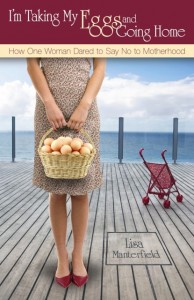
~ "a raw, transparent account of the gut-wrenching journey of infertility."
~ "a welcome sanity check for women left to wonder how society became so fixated on motherhood."